
The new generation of ablative laser technology: 2910 nm and the role of polynucleotides in skin regeneration
How innovative laser technology and regenerative skin treatments may reinforce each other.

By Marit van BoldrikPublished on 23 November 2026Originally written in Dutch by Medi-Invest and translated with the help of AI tools. Read the Dutch original.
At the recent NVCG congress, an interesting development in aesthetic medicine took centre stage: combining the latest generation of ablative laser technology at 2910 nanometres with polynucleotides. It is an approach in which not only the treatment outcome but also the skin's biological recovery process is receiving growing attention. It was presented by our co-owner Marit van Boldrik together with Dr Wang and Dr Adams.
Traditional ablative lasers, such as CO₂ (10,600 nm) and Er:YAG (2940 nm), have held an important place in skin improvement for many years. The introduction of the 2910 nm fibre laser opens up new possibilities to combine controlled skin ablation with thermal stimulation, with the aim of effective skin renewal and a favourable recovery profile.

What makes the 2910 nm fibre laser different?
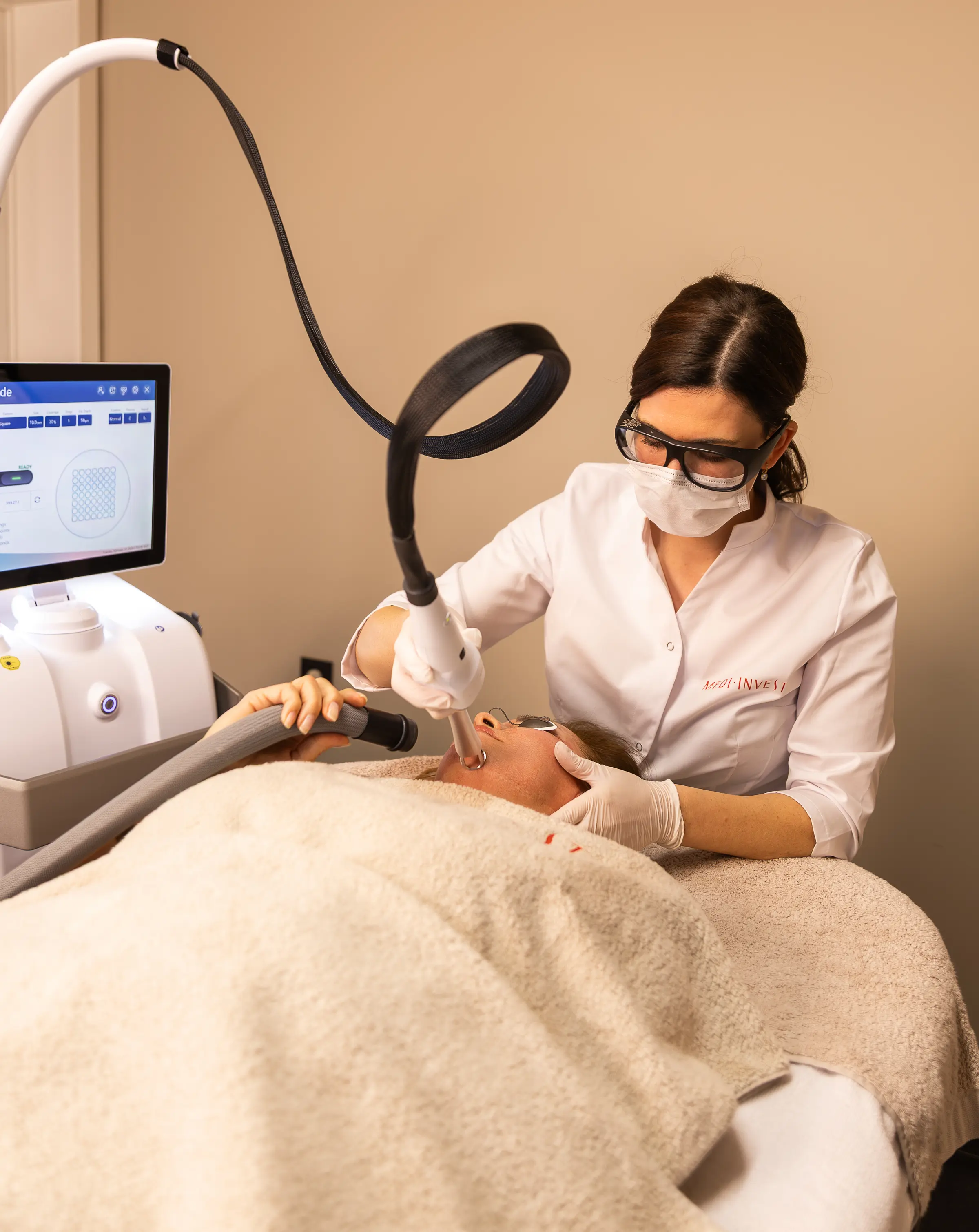
The 2910 nm fibre laser, used in the UltraClear, belongs to a new generation of ablative laser systems. Like traditional CO₂ and Er:YAG lasers, this wavelength targets water in the skin tissue.
Water absorption converts laser energy into heat, enabling controlled ablation of skin tissue. At the same time, depending on the treatment settings, thermal energy can be delivered to the surrounding tissue. This stimulates processes involved in collagen remodelling and skin renewal.
The difference lies not only in the wavelength, but above all in how the energy is delivered and how ablation and thermal stimulation can be combined within a single treatment.
2910 nm fibre technology allows both superficial skin renewal and more intensive treatments, with the practitioner able to tailor the balance between ablation, thermal effect and recovery time to the skin condition and treatment goal.
2910 nm versus CO₂ and Er:YAG: what are the differences?
In traditional CO₂ laser treatments, ablation is accompanied by a relatively pronounced thermal effect in the surrounding tissue. This makes CO₂ effective for skin renewal and collagen remodelling, but with more intensive treatments it can involve a longer recovery period and a higher risk of complications in pigmented and darker skin types.
The Er:YAG laser at 2940 nm has very high water absorption and therefore allows particularly precise ablation, usually with a more limited residual thermal zone at short-pulse settings. This can be advantageous for superficial resurfacing, but is less effective for skin tightening.
The 2910 nm fibre laser occupies an interesting position here. It is the world's first cold-fibre laser, with 95% ablation, which means coagulation can be fully adjusted as required. It is suitable for ageing at every stage and for all skin types, without compromising on effectiveness.
An important clinical advantage is the potential for shorter recovery time compared with conventional fractional CO₂ treatments, depending on the chosen settings and treatment intensity.
Beyond resurfacing: collagen remodelling and skin tightening
While ablative lasers have traditionally been associated mainly with improving skin texture, wrinkles and scars, the treatment of skin laxity is also receiving increasing attention.
2910 nm technology offers several treatment modalities, including laser-coring. In laser-coring, microscopic columns of skin tissue with a diameter of 370 microns are removed, with the aim of controlled tissue reduction and subsequent remodelling.
This approach is interesting for indications where, in addition to skin renewal, improved skin quality and skin tightening are desired.
Polynucleotides: supporting the regenerative process
Alongside developments in laser technology, there is growing interest in treatments that support the skin's natural ability to recover.
Polynucleotides are purified DNA fragments used in regenerative aesthetic medicine because of their influence on tissue repair, hydration and the extracellular matrix.
Depending on the formulation and application, various biological effects have been described:
- Supporting tissue regeneration: polynucleotides may support processes involved in cellular activity and the repair of damaged tissue.
- Improving hydration: thanks to their hydrophilic properties, they may contribute to a favourable moisture balance in the treated tissue.
- Supporting wound healing: experimental and clinical research points to possible positive effects on processes involved in tissue repair.
- Supporting the extracellular matrix: polynucleotides are being studied for their possible contribution to fibroblast activity and the processes surrounding collagen formation.
These properties make polynucleotides particularly interesting in combination with treatments that use controlled skin injury to stimulate regeneration.
Combining the 2910 nm laser and polynucleotides
An ablative laser treatment triggers a controlled tissue response that activates the natural wound-healing process. This process comprises several phases, from the initial inflammatory response to proliferation and long-term tissue remodelling.
The 2910 nm fibre laser already offers a relatively favourable recovery profile on its own. The question is whether this recovery can be further supported by applying polynucleotides directly after treatment.
The underlying hypothesis is that polynucleotides, through their potential regenerative and hydrating properties, may contribute positively to the restoration of the skin barrier and the wound-healing response.
Research is currently under way into whether this combination can actually lead to faster recovery, less prolonged redness and improved skin quality after treatment.
The future of ablative skin treatments
The development of the 2910 nm fibre laser shows that ablative skin treatments are evolving beyond simply removing superficial skin tissue.
Increasingly, the emphasis is on the controlled combination of ablation, thermal stimulation, tissue remodelling and the most predictable recovery process possible.
The possible combination with polynucleotides fits this development. It is not only the energy delivered to the skin that matters, but also the way the tissue subsequently recovers.
Frequently asked questions
Questions about the 2910 nm laser and polynucleotides
What is the difference between a 2910 nm laser and a CO₂ laser?
Both lasers target water in the skin, but a CO₂ laser produces a relatively pronounced thermal effect in addition to ablation. The 2910 nm fibre laser works with 95% ablation, which means coagulation can be fully adjusted as required. It also offers the potential for shorter recovery time, depending on the settings and treatment intensity.
What is laser-coring?
In laser-coring, microscopic columns of skin tissue with a diameter of 370 microns are removed. The aim is controlled tissue reduction and subsequent remodelling, for example in cases of skin laxity.
What are polynucleotides?
Polynucleotides are purified DNA fragments used in regenerative aesthetic medicine. They are used because of their influence on tissue repair, hydration and the extracellular matrix.
Knowledge base
Related equipment
Devices that often come up alongside this topic.

Want to know more about 2910 nm technology?
Curious what ablative 2910 nm laser technology could mean for your practice? We are happy to discuss the treatment options and how they fit your patients.